

By Kate Quick
As a career advisor, one of the most common questions I get asked is, “Can I put my study abroad experience on my resume ?” The answer is and always will be YES! And not only your resume, but on your LinkedIn profile and even in cover letters.
Whether you spent a week in Washington D.C. for Spring Break, a month of the summer in Costa Rica, or an entire academic year in France, your experiences spent in a new place have an abundance of transferable skills to your future career.
You also gain valuable experiences that will jumpstart your career! Research has shown that studying abroad can have a significant impact on getting and keeping jobs. Global Admissions reports that 80% of students reported that studying abroad allowed them to better adapt to diverse work environments and 70% claimed that they were more satisfied with their jobs due to their study abroad experiences. Additionally, IES Abroad conducted a survey and found that those who studied abroad were more likely to get a job quicker and at a higher salary.
Now, you may be thinking, “This all sounds great, but I still have no idea how to actually highlight to employers the skills and experiences that I gained.”
Let’s start with where you should put it on a resume! There are several spots where you can place study abroad experiences (IES Abroad).
If you were enrolled in a university in your host country, you can highlight your study abroad experience as part of your education. Underneath your current or most recently acquired degree (if you are a graduate), place the university title and the region or country of its residence. Since you most likely did not receive a degree here, you will want to highlight a concentration or relevant coursework. Be sure to add the dates that you were abroad!

On your LinkedIn profile, you can add that you were a guest student at a different university under the Education profile section.

Another spot to place your study abroad experience is under your Work Experience section. A benefit to this spot is that you can highlight key skills and experiences as bullet points. Placing it here is appropriate if you held an internship or some type of position while studying abroad. Even if you weren’t paid for your work, this is still considered work experience!

If you didn’t hold a true position while studying abroad, it is suitable to place your experience under some other section, such as Other Experience, Other Related Experience, Cross Cultural Experience, or Volunteer Experience. There is no right or wrong answer for how you title this section, but be sure that your experience is highlighted well and can be easily read when a hiring manager reviews your resume.
If you didn’t have an official “position” while studying abroad, give yourself one that encapsulates your experience and is tailored to the job that you’re applying for. Some examples may be Student or Volunteer.
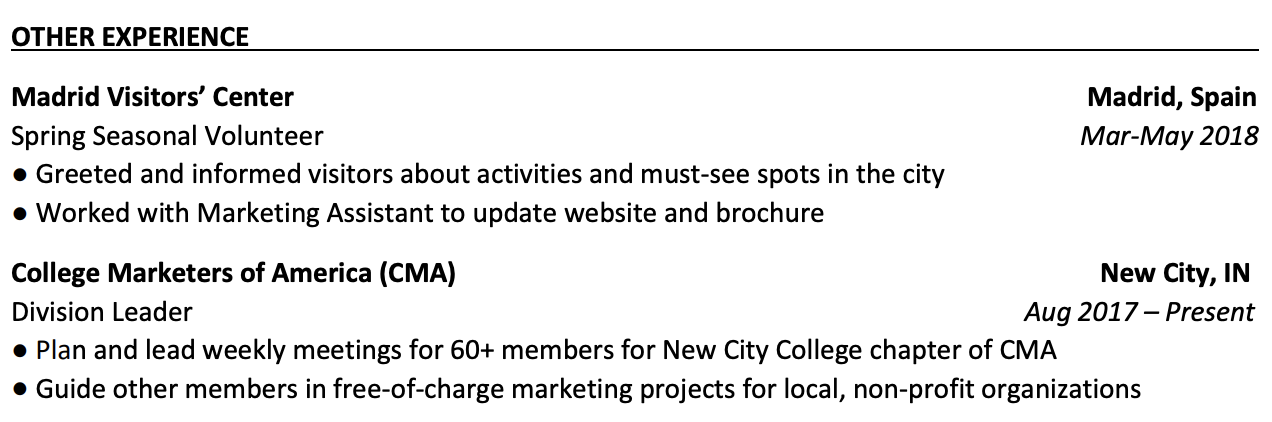
Feel free to add your study abroad experience to your LinkedIn profile as well! You can place it as one of the roles under Experience or as a Volunteer Experience.


Whether you put it as Work Experience or in another section, be sure to write strong accomplishment statements to highlight each problem/project that you worked on and the result of your hard work!
The last spot that can highlight your study abroad experiences is under a Skills section. Remember that on resumes, only hard skills should be included here. Some common hard skills students gain while studying abroad include new or improved language skills, research skills, project management, and technological skills.

You can also highlight skills that you gained on your LinkedIn profile. These can be hard or soft!
Some soft skills that you likely acquired while studying abroad are things such as adaptability, communication, cultural awareness, curiosity, problem-solving, confidence, teamwork, and resilience.

Last but not least, when considering writing a cover letter and which evidence you should provide the hiring manager on your work ethic and previous experiences, consider adding studying abroad as evidence to support your case that you are the right fit for a position.
Consider the following skills and if you believe these to be relevant to your life:
- Skill 1: Adapting to a new cultural and/or professional environment
- Mention your ability to handle ambiguity and stay positive.
- Skill 2: Effectively communicating across cultures
- Consider any events, presentations, or volunteer work that you participated in while in your host country.
- Skill 3: Being flexible
- Describe the steps that you took to mitigate challenges abroad?
- Skill 4: Multitasking
- Emphasize your ability to keep organized in a new work culture.
Studying abroad is truly a one-of-a-kind experience that will not only be personally rewarding, but professionally rewarding. If you have the chance to study abroad, consider it! And if you have already studied abroad, be sure to add it to your Career Toolkit.
For more information on the study abroad programs offered through DePaul University, check out the Study Abroad webpage.
~~~~~~~~~~~~~~~~~~~~~~~~~~~~~~~~~~~~~~~~~~~~~~~~~~~~~~~~~~~~~~~~~~~~
Need help identifying your transferable skills? Wanting to showcase and market your skills to employers? Looking to upskill on certain skills? That’s exactly where we come in. Whether you’re a freshman or an alumnus, it’s never too early (or too late) to get started with transferable skills. Book an appointment with Kate, or another member of the advising community through Handshake, or by calling the front desk at (773) 325-7431.